
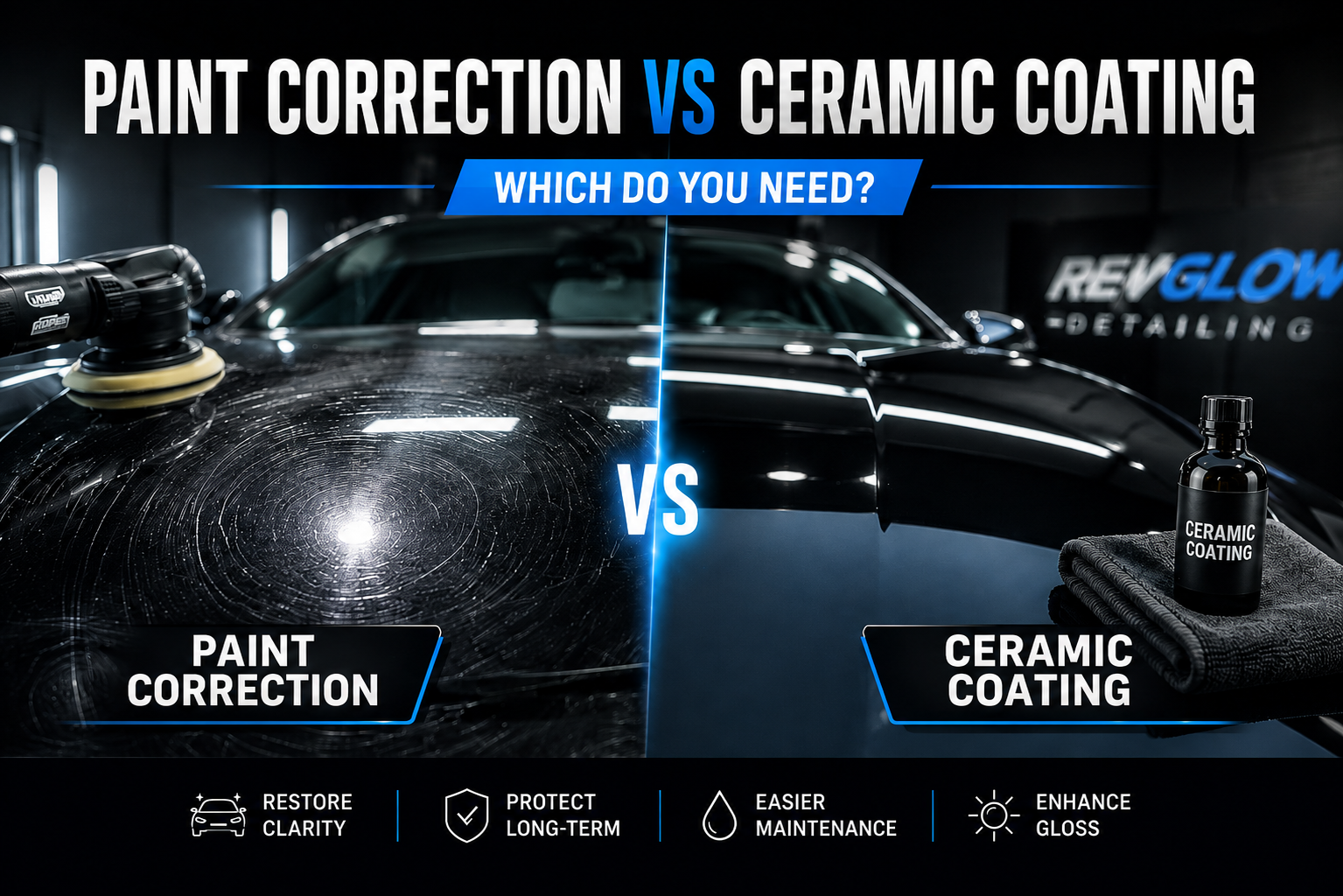
Paint Correction vs. Ceramic Coating: Which Do You Need?

When clients bring their vehicles to my shop asking whether they need a ceramic coating or paint correction, I always tell them to look at their ultimate goal for their car’s appearance. Many car owners assume these two treatments do the exact same thing. In reality, they serve two distinct purposes. If your car’s paint suffers from a dull haze, fine scratches, or suitable swirls, applying a coat of protection won’t fix those underlying surface defects. Instead, you need a targeted correction step to smooth out those light surface defects. This step truly restores the depth and gloss of your finish.
On the flip side, ceramic coating is the key if your primary objective is long-term defense against environmental elements and making your routine cleaning effortless. However, armor is only as good as what lies underneath. The clear coat must be properly prepared before any protective chemical layer is laid down. Jumping straight into adding protection without proper preparation will simply lock in existing blemishes forever. That is why understanding the right sequence matters so much when caring for your vehicle, ensuring that resurfacing comes before sealing.
Every vehicle that enters a shop requires a thorough hands-on inspection before any action is taken. Once the finish is physically inspected, a detailer can determine the exact level of correction necessary to achieve the desired result safely. Sometimes a full multi-stage process is essential. Other times, a limited improvement step is all that is required to bring back that showroom shine. Knowing the particular level of correction needed prevents over-polishing. This keeps the clear coat healthy while giving you the longer-lasting protection and stunning clarity you expect.
Ultimately, executing these steps in the correct sequence guarantees that you aren’t wasting time or money on unnecessary services. By focusing first on fixing defects through dedicated paint correction and then shielding that freshly polished finish, your cleaning regimen becomes much easier over time. Understanding what your car specifically demands ensures you select the right process for your vehicle’s current condition.
Understanding Paint Correction: How It Works, Realistic Limits, and Safe Preservation
In my years working in auto detailing, clients frequently ask what Paint Correction actually accomplishes for a car. At its core, this process relies on controlled machine polishing. It uses specialized compounds, fine polishes, and suitable pads to refine the vehicle’s clear coat.
Through meticulous refinement, we gently level out micro-imperfections. These include light swirls, deep wash marring, environmental oxidation, and minor scratches.As we smooth the top layer, surface uniformity improves dramatically. Reflected light then bounces cleanly, giving the panels a completely uniform look with a deep, mirror-like gloss.
However, I always explain to vehicle owners that true correction is not a miracle fix or a replacement for total repainting. A technician must establish a responsible scope because all work must stay within a strict safe working range to protect the underlying paint. Severe damage such as structural rust, dented body damage, stone chips, or failing clear coat cannot simply be buffed out. That is why I never make a blanket claim that every single flaw can be removed. Prior to starting, a thorough physical inspection is necessary to evaluate the physical scope of the vehicle and distinguish standard defects from permanent deep scratches.
Ultimately, professional correction focuses on balancing immediate appearance improvement with the long-term preservation of the vehicle’s remaining finish. By prioritizing safe defect removal, we minimize the visibility of daily wear without compromising the structural integrity of the paint. Once the finish is brought back to peak visual clarity, many owners opt to apply a protective ceramic coating to seal in those results and keep the car looking immaculate.
Understanding Ceramic Coatings: Real Benefits, Practical Limits, and Proper Maintenance
In my years running a detailing shop, I often see car owners expecting miracles from a ceramic coating. When applied to a properly prepared exterior surface, the product chemically bonds to the clear coat, forming a durable protective layer over your factory paint. The real practical value here lies in transforming how the surface behaves day to day—specifically improving its water behaviour through high hydrophobicity so dirt glides off effortlessly, making the vehicle much easier to wash.
However, I always explain to vehicle owners that true correction is not a miracle fix. It is not a replacement for total repainting. A technician must establish a responsible scope. All work must stay within a safe range to protect the underlying paint. Severe damage cannot simply be buffed out. This includes structural rust, dented body panels, stone chips, or failing clear coat.
That is why I never claim that every single flaw can be removed. Prior to starting, a thorough physical inspection is necessary. This evaluates the vehicle’s condition and distinguishes standard defects from permanent deep scratches.
To maintain peak performance over the years, routine maintenance cannot be ignored. You still need to practice careful washing techniques using pH-neutral shampoos to prevent marring the protective surface. Proper aftercare, including periodic decontamination washes, ensures the layer remains hydrophobic and continues to preserve your paint’s high-gloss finish for years to come.
The Key Difference
When clients come to my shop asking how to choose between services, I like to explain the core difference using a simple home renovation analogy. Imagine you are painting a wall in your house. If that wall is covered in deep holes or surface scuffs, you would naturally fill those gaps and sand the drywall smooth before putting on a fresh coat of paint. Following that exact same logic, paint correction is responsible for repairing existing damage on your vehicle, whereas applying a ceramic coating is all about shielding the vehicle from future damage.
Understanding this distinction is vital because a coating simply seals whatever is currently on the surface. If you skip fixing the clear coat on cars—particularly older daily drivers—you end up with permanent visual defects. Any visible swirls, minor damage, or deeper flaws will become trapped and locked beneath that clear protective layer forever. That is why the proper order of operations in professional detailing always places surface restoration before surface preservation.
If your vehicle’s paint is already in good condition, you might be able to go straight to applying a protective coating. However, most vehicles benefit from at least a gentle light polish or minor correction step to clean up micro-marring before any final product goes on. Taking the time to perform proper correction ensures that your surface restoration and protective ceramic coating work together seamlessly to deliver flawless, long-lasting results.
Pro’s & Con’s of ceramic coating & paint correction
| Feature / Category | Paint Correction | Ceramic Coating |
| Pro’s | Permanently removes light scratches, swirl marks, wash marring, and oxidation. | Long-lasting protection (1 to 5+ years vs. weeks/months for wax). |
| Pro’s | Restores peak gloss and optical clarity of clear coat. | Extreme hydrophobic effect (water, mud, and grime wash off effortlessly). |
| Pro’s | Creates a smooth, uniform surface essential for coating adhesion. | Dramatically easier routine washing and maintenance. |
| Pro’s | Elevates overall vehicle appearance and resale value | Protects clear coat against UV rays, acid rain, bird droppings, and oxidation. |
| Feature / Category | Paint Correction | Ceramic Coating |
| Con’s | Removes a thin layer of clear coat (clear coat thickness is finite). | Does NOT remove existing scratches or swirls (locks defects under coating). |
| Con’s | Labor-intensive and time-consuming process (5 to 20+ hours). | Does NOT prevent rock chips or mechanical scratch impact (requires PPF) |
| Con’s | No future protection against chemical etching or environmental damage on its own. | High upfront cost for professional surface prep and application. |
| Con’s | Cannot repair deep scratches passing through clear coat, rock chips, or failing clear coat. | Requires precise environment and curing time. |
| Con’s | Higher labor cost due to skilled technician requirements. | Requires proper maintenance (pH-neutral soaps, periodic decontamination). |
FAQ’s
Is PPF better or ceramic?
Paint Protection Film (PPF) is objectively better for physical damage like rock chips, deep scratches, and parking scrapes because it is a thick, physical barrier. However, ceramic coating is better for chemical protection, high gloss, and easy cleaning at a much lower cost.
Can I ceramic coat without paint correction?
Yes, you can apply a ceramic coating without paint correction, but you will lock in existing scratches, get slightly less bonding durability, and miss out on a mirror finish
What destroys ceramic coating?
Ceramic coatings are tough, but they can be degraded or stripped by abrasive machine polishing, very harsh high-alkaline or acidic chemicals (outside pH 6-8), heavily neglected environmental contamination like hard water spots and bird droppings, and automated brush car washes. They wear down molecularly rather than peeling off.
Do I need paint correction before getting a ceramic coating?
Yes, in almost all cases. Ceramic coatings bond semi-permanently to your vehicle’s clear coat. If you apply a coating without correcting the paint first, any existing scratches, swirl marks, or water spots will be permanently locked underneath the protective barrier.
Can paint correction protect my car’s paint on its own?
No. Paint correction only restores the optical clarity and flatness of the clear coat—it leaves the paint completely bare and exposed to the elements. Once correction is complete, the surface must be sealed with a ceramic coating, paint protection film (PPF), or sealant to prevent rapid deterioration.